Why Erik Wilde Joined WunderGraph


We are seeing a revival of APIs. People may not always call it that, but organizations everywhere feel a renewed urgency to make their context and capabilities available to AI. Context is what goes into AI, so that it can make good decisions. Capabilities are what AI needs to actually do things, instead of just talking about them. Both need to be accessible, they need to be usable and useful for AI, and they need to be secured accordingly.
Some of this sounds like traditional API work, and to some extent it is. But a fair bit of it is new, and it is changing the API space. Governance, scale, and security are back at the center of the conversation, and how organizations handle them will decide whether their AI efforts make it past the demo stage.
WunderGraph is in a good place for this. It has a solid base of established customers, so it has shown that it can deliver. And it has a convincing story for what agents need: the right context and capabilities, at scale, and properly secured. I particularly like the governance part. With federation, many of the hard governance tasks are taken care of by design, instead of being something you have to bolt on later with brittle informal processes.
Looking back, my career always followed one question: What does it take to make large-scale information systems work? Part of that is technology: What are the pivotal technologies of the time, and what's keeping them, or their adoption, from reaching their full potential? The other part is what it takes for organizations to actually make these technologies work for them. I have always enjoyed the combination of the two: framing new technologies, explaining them, putting them into practice, and establishing patterns that help people use them in a way that delivers on their potential.
I have known Jens for a long time, basically since he started WunderGraph. Earlier this year we recorded a podcast episode together, which was my first closer look at where WunderGraph was heading. Now I am fully on board.
For quite a while now, my motto has been "Getting APIs to Work" . That overall focus is not going anywhere. APIs in the traditional sense have a long future ahead of them, and we need to keep an eye on that. But my specific focus is now shifting to "Getting APIs to Work with AI".
Many organizations are still struggling with that. Some have a hard time getting pilots off the ground, which can take surprisingly long. Others did build successful pilots, but now struggle to turn these into practices that scale. WunderGraph has a very good story for both: we make it easier to get that pilot going, and we make sure that what you invest in it already is an investment in scaling later. My job is to help develop and communicate that story, and to help with the practices and patterns that turn individual projects into the scalable AI enablement that so many organizations are looking for.
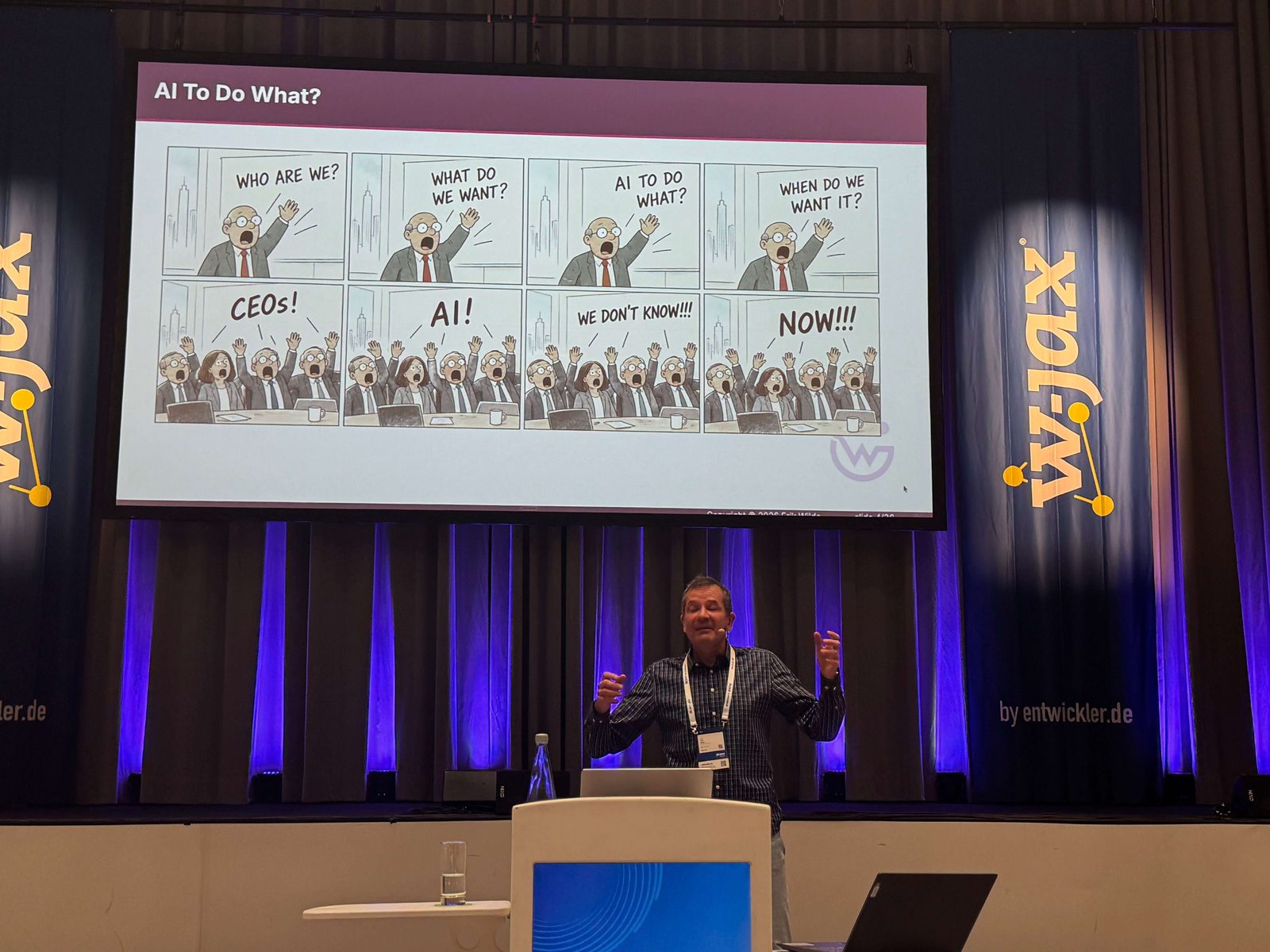
If you are trying to get your AI initiative going, get pilots unstuck, or scale your AI practices, get in touch. My first appearance as WunderGraph's Chief Evangelist was at W-JAX in Munich (that's where the photo above is from). Next, you can find me mid-November at the Software Architecture Gathering and at the API Conference , both in Berlin, and at the beginning of December at API Days Paris .
Fun times ahead!

Chief Evangelist at WunderGraph
Erik Wilde is the Chief Evangelist at WunderGraph, where he helps organizations with “Getting APIs to Work with AI.” He co-authored O’Reilly’s Continuous API Management and has authored IETF standards for HTTP APIs, including Problem Details (RFC 9457), the Deprecation header (RFC 9745) and the Sunset header (RFC 8594). He holds a PhD in computer science from ETH Zurich and has taught web architecture at ETH Zurich and UC Berkeley. His career has followed one question: what does it take to make large-scale information systems work?