Customer Success as Federation: A Layer for Context and Trust
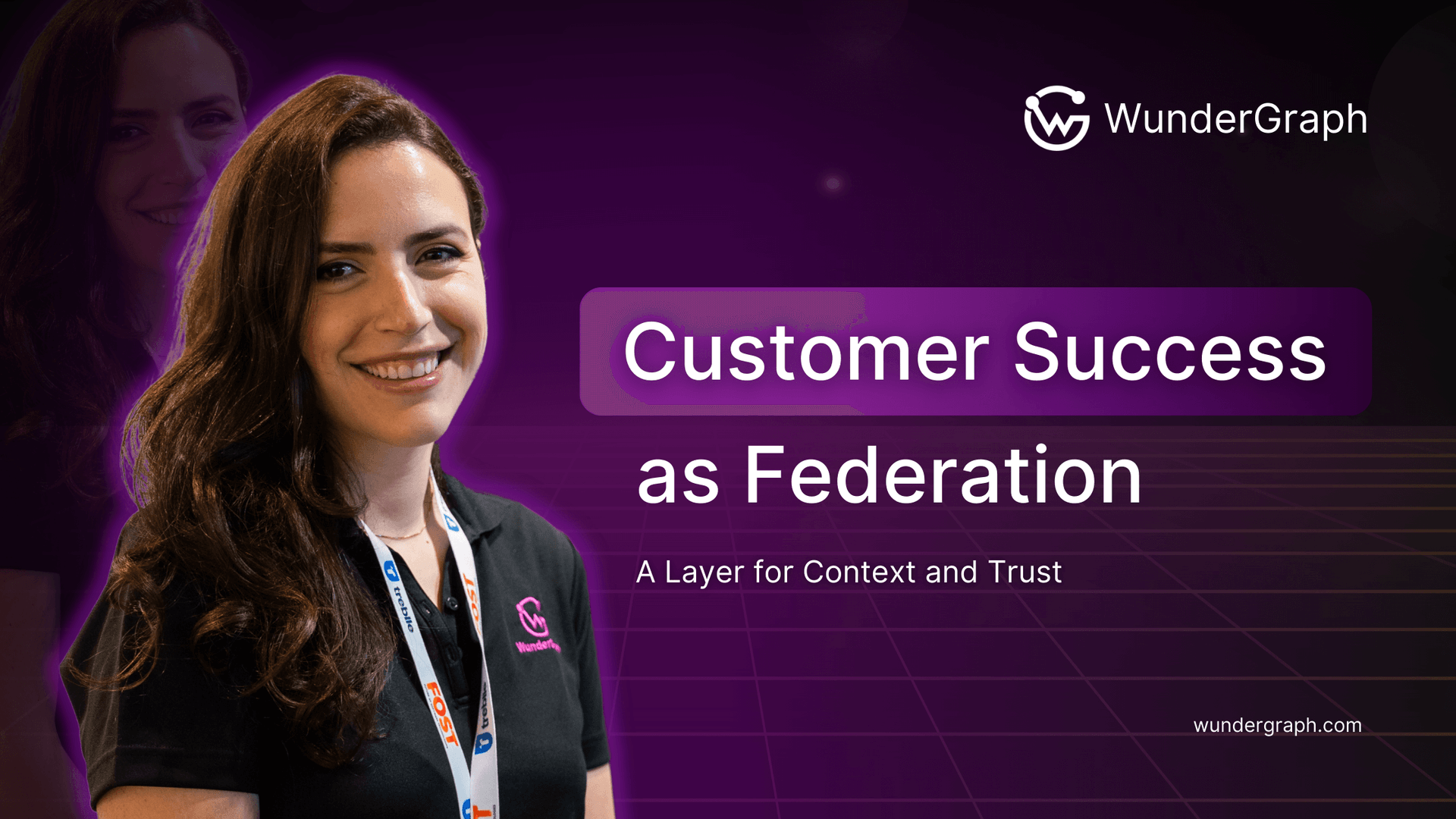

When it works well, it creates shared context and trust. That is what makes teams effective.
Most SaaS companies have a design flaw in how they structure Customer Success. They build it as a queue, a buffer between engineering and frustrated customers, and then wonder why trust does not scale.
A queue is the right structure for processing volume. It is the wrong structure for carrying context.When customer relationships get routed through a ticket system, requests get handled but understanding gets lost. And once that understanding is gone, it is very hard to get back.
I often think about Customer Success the same way our platform works at WunderGraph. Different services, different owners, connected by one layer. If that layer fails, the whole experience degrades.
CS plays a similar role inside a company.
It sits between product, engineering, documentation, marketing, and sales.
It does not just relay tickets. It carries context. It translates sentiment. It surfaces patterns. It ensures decisions are grounded in what customers are actually experiencing.
In that sense, CS is federation. Independent teams connected through a reliable layer.Not automated routing, but something more interpretive. A human layer that carries context the way a technical system carries data, with judgment standing in for deterministic logic.
If product, engineering, documentation, marketing, and sales are independent services, the customer experience is the composed graph.
Each function owns its domain. Product owns roadmap and direction. Engineering owns implementation and trade-offs. Sales owns commitments and commercial context. Marketing owns narrative and market communication. Documentation owns clarity. They evolve independently, with their own priorities and constraints.
But none of those domains are useful to the customer in isolation. Value appears when they are composed into something coherent.
When internal alignment drifts, the customer feels it immediately when commitments, roadmap, and reality no longer line up.
Strong federation inside a company means the customer does not have to navigate organisational boundaries because the connective layer does it for them.
Federation only works when services align around a shared schema and clear ownership. The same is true across teams.
When critical context isn't captured, decisions degrade. In technical systems, missing fields mean unresolved queries. In organisations, missing context can lead to repeated mistakes.
Sometimes that means adding structure by tracking use case maturity or tagging feature requests with revenue or regulatory impact. Not for reporting’s sake, but to make important context visible and usable across teams.
Customer Success often sees those missing fields first, because we are the ones watching the queries fail in real time.
The parts of this role that matter most are also the hardest to hand off. I've written about why customer success cannot be automated . What follows is the structural argument behind that.
Pattern recognition is one of them. When you have worked with enterprises adopting software for years, you start to notice shifts before they are named. You can sense when excitement is building toward expansion, and you can sense when something feels fragile. Those signals appear gradually, across conversations and stakeholders, and they rarely arrive as structured data.
Tone is another. A short "that's fine" can mean three different things. A delayed reply can signal risk, and a change in who joins a call can indicate reprioritisation happening above the person you talk to most. AI is excellent at summarising calls and extracting action items. But it cannot maintain a live picture of a customer relationship, one where the same words mean different things depending on who says them and when, and where something that worked last quarter starts showing cracks for reasons that never appear in a summary.
Then there is the cross-industry pattern matching that only comes from time. A logistics company struggling with data governance may have the exact same underlying problem a telecom company surfaced months earlier.
Connecting those dots requires remembering the shape of problems, not just their wording. And underneath all of it is accountability. Humans feel it when something slips. That feeling sharpens judgment in a way that is difficult to replicate.
Every connective layer has to handle requests it cannot fulfill. The question is whether a refusal is a dead end or a useful response.
When a system rejects a request well, it returns enough information for the other side to understand why and what to try instead. CS works the same way. Saying no without context breaks trust. Saying no with transparency about direction, trade-offs, and timeline keeps the relationship intact.
The first question is whether the request is genuinely urgent or whether the customer is solving a structural problem in their own stack by shifting it to yours. Taking time to clarify often changes the tone of the conversation. Sometimes the request is less critical than it first appeared. Sometimes it is more.
If the roadmap already covers the request, say so. If it does not, acknowledge that openly. Misalignment between what you are building and what customers are asking for is a signal, not an inconvenience.
When something goes to the backlog, pressure-test the reasoning from the customer's perspective. If the explanation feels weak, refine it or revisit the decision. The goal is not to avoid refusal. It is to ensure the customer never feels dropped.
A connective layer only works if the teams it serves trust that it is routing information accurately, without distorting it to serve its own interests.
That trust breaks down when CS carries a quota.When the same person responsible for trust is also negotiating contracts, the dynamic changes.
It becomes harder to be seen as an extension of the customer’s team when you are also discussing commercial terms.
That does not reduce CS’s commercial impact. Quite the opposite, in fact.
The goal is to create customers who want to renew because the relationship works and the product delivers value. Retention driven by trust is stronger than retention driven by pressure.
Drawing that boundary is not always easy, but it protects the integrity of the role. This does not mean CS ignores commercial reality. It means trust should not depend on commission.
At WunderGraph, we have designed our CS function around this principle. Keep the human in the loop. Build systems that support collaboration rather than replace it.
If you over-automate, you lose more than manual effort. You risk losing the shared thinking and conversations where patterns emerge.
Over the past six months, since restructuring CS around shared context ownership rather than ticket forwarding, we have seen a 96 percent reduction in support tickets escalated to other divisions.The shift was structural. Clearer ownership boundaries. Direct engineering feedback loops. A deliberate decision to keep CS in the loop instead of routing issues away prematurely.
Customers did not stop encountering issues. Context reached the right people earlier, so escalation became prevention.
Companies can automate workflows. They cannot automate shared understanding.
If Customer Success is reduced to efficiency metrics or revenue targets, trust becomes conditional.
If it is designed as a federation layer for context, trust compounds.
If you want to go deeper on how we think about this at WunderGraph, I spoke about it in more detail on The Good Thing .

Head of Customer Success at WunderGraph
Viola leads Customer Success at WunderGraph, building scalable support processes while keeping engineers close to customer outcomes. With a background in solutions engineering and UX research, she turns feedback into actionable product insights and smooth onboarding. She champions empathy, clear communication, and data-driven triage to help teams ship with confidence.