The Hidden Cost of Non-Compliance in AI

Every AI deployment now carries audit risk.
For high‑risk AI in Europe, logging and documentation are written into law. In the United States, states are building their own playbooks with no consistency. In parts of Asia, certain high‑impact AI systems increasingly face mandatory risk assessments and, in some cases, pre‑deployment regulatory scrutiny. Every rule change has the potential to slow delivery.
Non-compliance no longer ends with a fine. It blocks sales, delays integrations, and forces engineers to rebuild systems under pressure. The impact appears as missed deadlines and eroded trust.
The only sustainable path is to make compliance part of the design. Build systems that record evidence as they run, so audit evidence is readily available when needed.
Teams using platforms like WunderGraph Cosmo already treat auditability as part of runtime design.
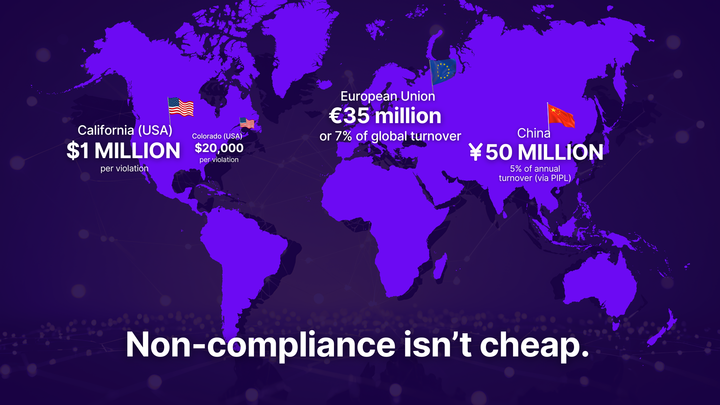
Regulation is now a global patchwork. The same model can be legal in one region and non-compliant in another. As restrictions are created or vetoed in quick succession, understanding the pattern matters more than memorizing the rules.
Despite regional differences, every regulatory framework ultimately asks for the same proofs:
What was shipped: models, configurations, schemas, and artifacts.
Who changed it: access logs, RBAC or SSO identities, approvals, and version history.
How changes were governed: linting results, governance checks, signed configs, and CI-based controls.
These layers clarify what auditors mean when they ask for “documentation” or “technical files.”
The EU AI Act entered into force on August 1, 2024. The Digital Omnibus on AI (Regulation (EU) 2026/1744, in force since July 27, 2026) then deferred the Chapter III high‑risk obligations: standalone (Annex III) high‑risk systems must comply by December 2, 2027, and high‑risk systems embedded in regulated products (Annex I) by August 2, 2028 . The deferral covers only Chapter III; transparency and other obligations remain on their original schedule.
Once those obligations begin, high-risk AI providers must:
- Generate and retain logs for at least six months, and longer where necessary, based on the system’s purpose or other EU/national laws.
- Keep technical documentation and compliance records available for 10 years after the system is placed on the market or put into service
Separately, transparency obligations under Article 50 , in force since August 2, 2026, apply to AI systems based on specific use cases (e.g., deepfakes), rather than on their high‑risk classification. In cases such as synthetic or deepfake content, providers or deployers may be required to disclose or label AI-generated or AI-manipulated material.
Fines can reach up to €35 million or seven percent of global turnover, depending on the type of infringement. The details vary, but one point is clear: evidence needs to exist before deployment, not after.
With no comprehensive federal law, the states have taken over.
In the 2025 session alone, lawmakers in all 50 U.S. states considered at least one AI‑related bill or resolution, turning the patchwork problem from theory into day‑to‑day reality (National Conference of State Legislatures ).
Colorado repealed its original AI Act (SB24‑205) before it took effect and replaced it with SB26‑189 , signed May 14, 2026. The new law regulates covered automated decision‑making technology (ADMT) that materially influences consequential decisions in domains such as employment, housing, credit, insurance, health care, education, and essential government services. It requires developer documentation for deployers, pre‑use consumer notices, plain‑language disclosures within 30 days after an adverse outcome, and a path for data correction and meaningful human review. Impact assessments, risk‑management programs, and the prior duty to avoid algorithmic discrimination were removed. Key obligations take effect January 1, 2027, with Attorney General rulemaking clarifying disclosure requirements.
California takes a different angle, targeting frontier models rather than use cases. SB 53 (signed September 29, 2025) requires large frontier-model developers to publish safety/transparency disclosures and report certain critical safety incidents within 15 days, or within 24 hours when there is imminent risk of death or serious injury. SB‑53 enforces these duties through civil penalties that can reach seven‑figure amounts per violation, enforced by the Attorney General.
New York maps high-risk directly to employment. The proposed Workforce Stabilization Act (A5429A) would require AI impact assessments before workplace deployment and would impose tax surcharges when AI displaces workers. In practice, this treats employment related AI as inherently high risk and mandates documented assessments upfront, not after the fact.
Texas pursued both youth safety and AI governance through parallel legislative tracks during the 89th session. On youth protection, lawmakers advanced age-verification, parental-consent, and disclosure obligations in online‑safety bills such as SB 2420 (the App Store Accountability Act), which would target online services used by minors.
The Texas Responsible Artificial Intelligence Governance Act (HB 149) , signed June 22, 2025, and effective January 1, 2026, establishes statewide consumer protections, defines prohibited AI uses, and creates enforcement mechanisms, a regulatory sandbox, and an AI Council. While still less expansive than EU-style high-risk regimes, Texas now imposes compliance debt across both consumer-facing and youth-focused AI systems through logging, consent, transparency, and governance requirements that must be designed, rather than bolted on.
Utah requires disclosure when consumers interact with generative AI and mandates stricter upfront disclosure for licensed professions and designated ‘high‑risk’ AI interactions. A “high‑risk” interaction generally involves sensitive personal data or AI‑generated advice that could reasonably be relied on for significant personal decisions, such as financial, legal, medical, or mental‑health guidance. The state defines obligations around transparency rather than consequential decision categories, adding another distinct compliance layer.
Each state treats 'high-risk' differently—employment decisions, youth safety, frontier models, discrimination, and transparency. Engineering teams now need to design for multiple compliance targets, with no federal standard to unify them.
China mandates lawful training data , consent for personal information, and clear labeling for synthetic content .
India initially proposed stricter draft guidance that pointed toward mandatory government approval for some AI systems in early 2024, then revised its advisory and removed the explicit government-permission language , while continuing to emphasize transparency, consent, and content safeguards .
South Korea’s AI Basic Act , effective in 2026, will add mandatory risk assessments and local representation for high-impact systems. These measures move South Korea toward a more formal pre‑deployment review model for high‑impact systems.
Brazil’s draft AI framework focuses on transparency, accountability, and human oversight and would give regulators authority to define “high‑risk” by sector and enforce additional disclosure rules over time. For global teams, planning for compliance is a moving target with shifting thresholds that can trigger new audits and delays even after launch.
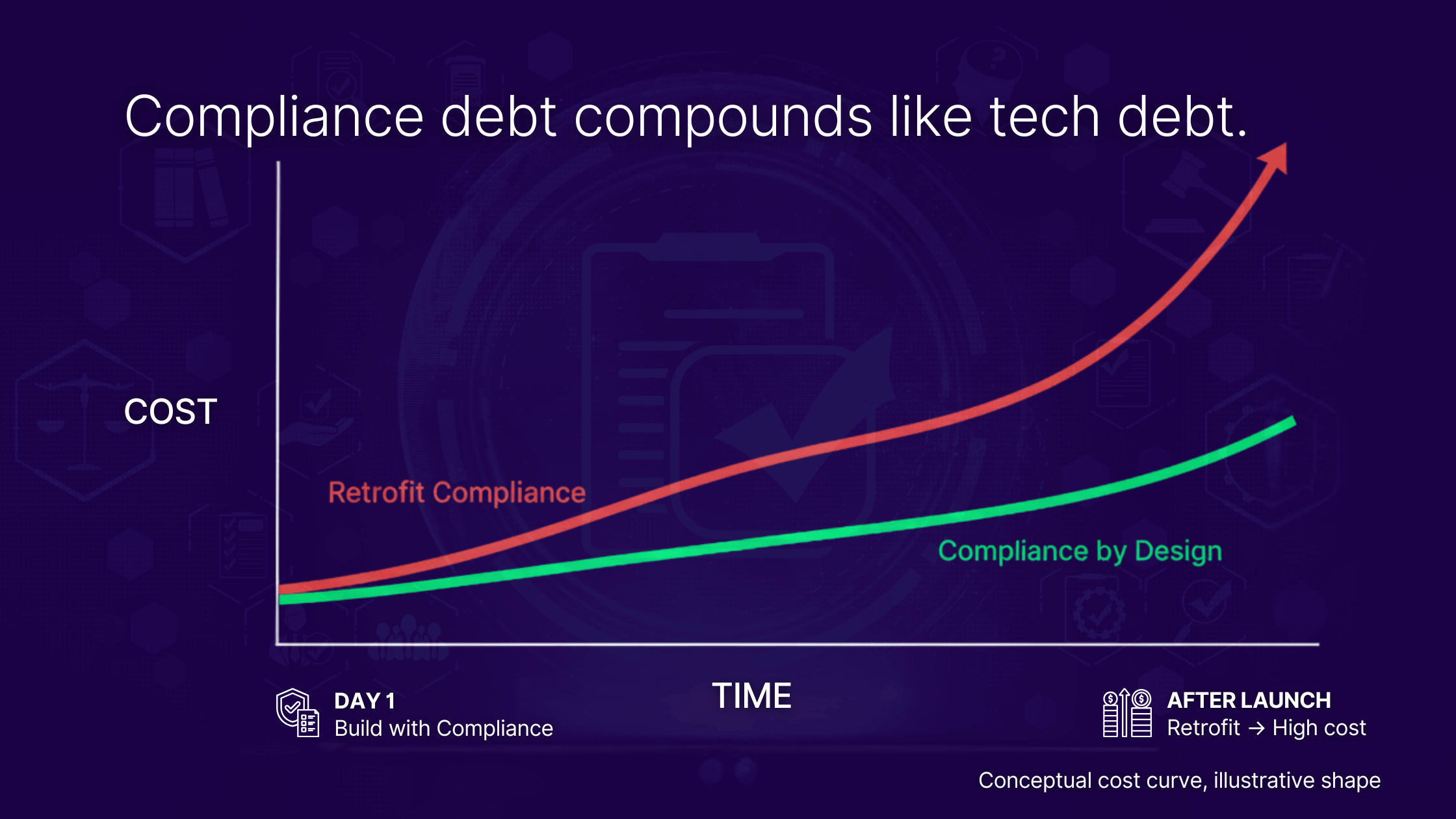
Most teams only discover compliance gaps after receiving an audit request or losing a deal.
By then, every fix burns more budget and calendar time.
Below are the recurring costs companies face when they treat regulation as a paperwork problem instead of a system design issue.
| Category | Description | Example |
|---|---|---|
| Fines | Legal penalties up to €35 M / 7 % of global annual turnover | EU AI Act Article 99 |
| Retrofit engineering | Rebuilding logs, RBAC, or documentation after launch | 3-5x cost multiplier vs. designing controls upfront |
| Audit overhead | Separate audit cycles for EU, California, and child-safety laws | Recurring review cycles under the EU AI Act and California SB‑53 |
| Disclosure tooling | Provenance tagging and detection requirements | AB-853 and India transparency requirements |
| Legal exposure | No “AI did it” defense in liability cases | Emerging AI liability doctrines and product‑liability case law emphasizing that companies cannot avoid responsibility by blaming algorithmic systems. |
| Fragmented builds | Conflicting rules across regions | Extra test and release tracks |
| Operational risk | Incomplete or missing logs break required audit trails | Conflicts with EU AI Act quality and traceability expectations and undermines SB‑53 safety‑documentation and incident‑reporting obligations |
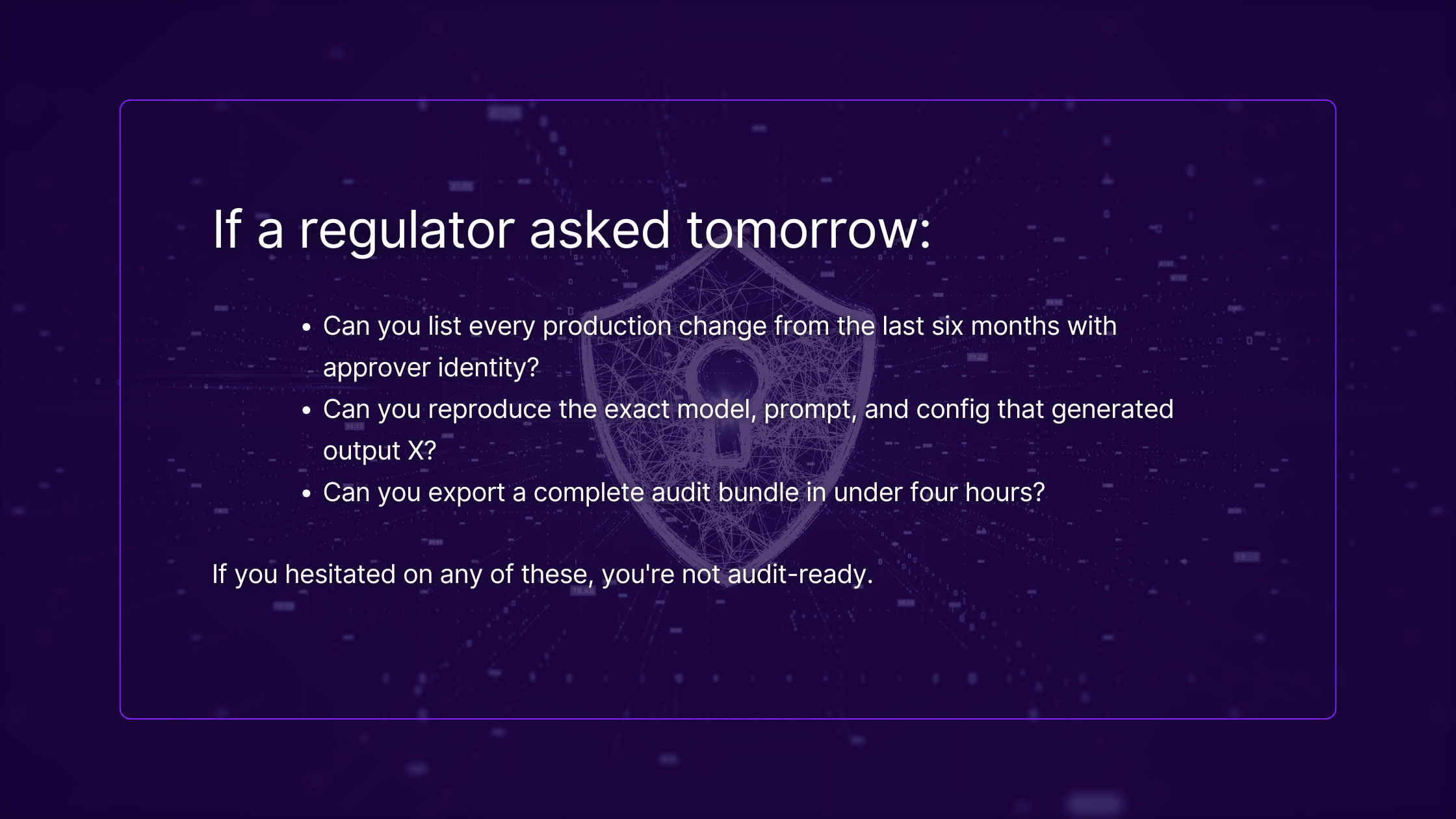
Regulation moves faster than retrofits. The only sustainable path is to build auditability into the runtime itself.
This is one of the principles that drives platforms like Cosmo, where logs, contracts, and policies exist as code.
Audit-ready logs provide immutable, identity-linked events that allow teams to replay a decision path. If you cannot reconstruct what happened, you cannot satisfy traceability requirements.
Policy enforcement in CI prevents misconfigured models or insecure schemas from entering production. Every blocked change becomes an approval record, strengthening the evidence trail.
Access governance connects each action to a verified identity through SSO , SCIM , and RBAC . This creates a chain of accountability that enforcement agencies can verify.
Versioning links prompts, models, and configurations to their exact commit or revision. This establishes a reproducible audit history for every component.
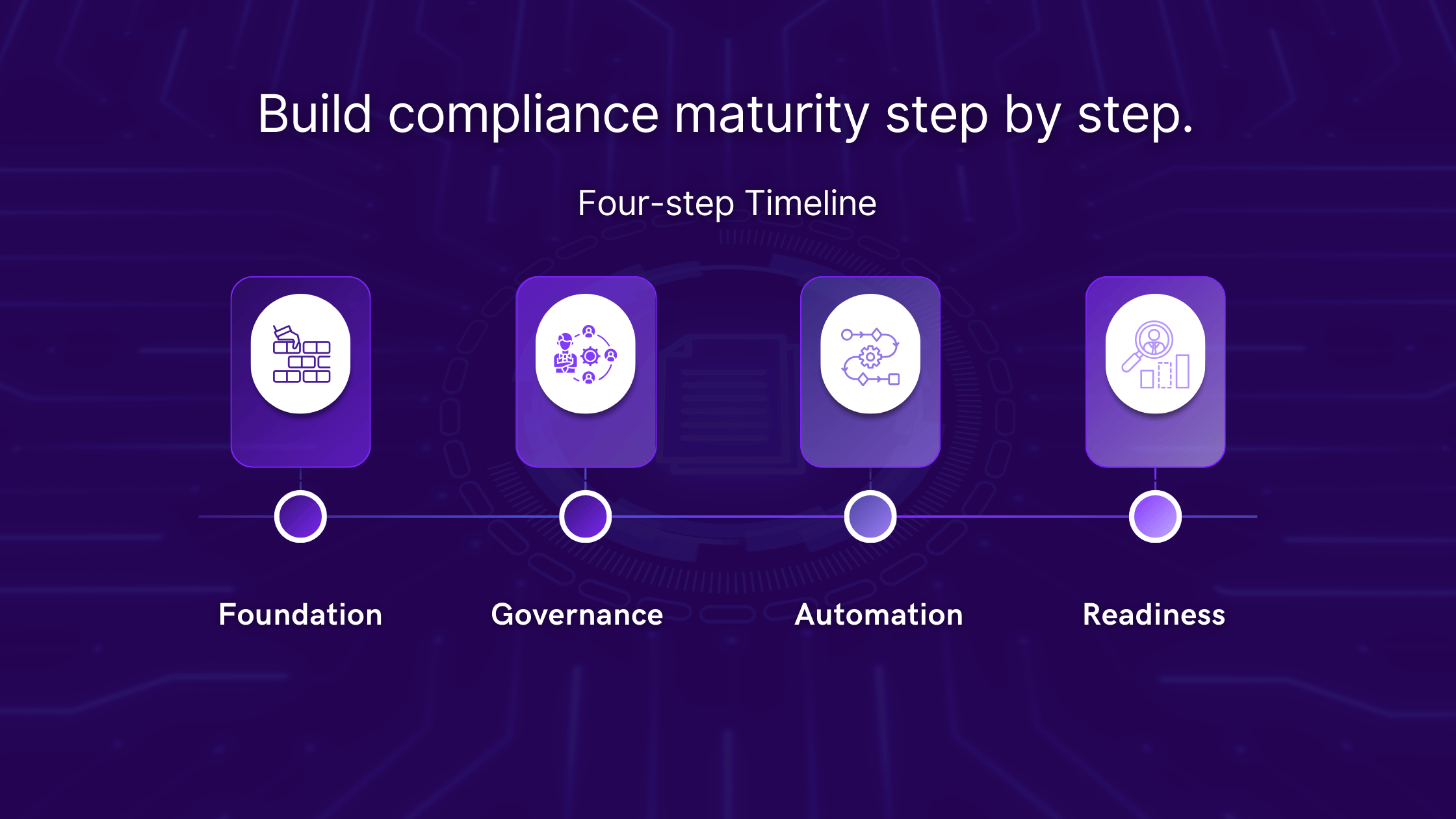
Compliance is not a project with an end date. It is a maturity path that moves from visibility to automation. Each step reduces manual effort and future audit risk.
These are practical indicators of maturity that turn compliance from theory into practice.
| Stage | Focus | Outcome | Success Metric |
|---|---|---|---|
| Foundation | Enable structured logs and retain them for at least six months | Satisfies EU AI Act six-month log retention and basic traceability requirements. | Log retention ≥ six months |
| Governance | Introduce schema contracts, policy linting, and SSO | Creates traceable change control | Audit-trail completeness ≥ eighty percent |
| Automation | Version models, prompts, and policies | Builds continuous evidence without extra work | All components versioned |
| Proof | Export audit bundles by region and validate documentation chains | Demonstrates compliance readiness on demand | Audit-pack assembly in hours |
Although not a legal term, preparing region-specific compliance documentation “bundles”, or audit bundles, can help streamline audit responses for international companies, while ensuring all required evidence is available by jurisdiction.
Tracking these metrics transforms compliance from a legal chore to an engineering capability.
When evidence generation becomes part of normal operations, regulation stops being a blocker and starts acting as a quality signal.
Everything described above already exists in production.
WunderGraph Cosmo is designed so these principles can be applied by default in production systems:
- Schema Contracts version and validate every change to turn governance into code.
- Audit Logs and Policy Linting capture real-time evidence at every commit and deployment.
- SSO and RBAC ensure traceable accountability across teams and environments.
The result is a system that generates proof automatically — the foundation of audit-ready AI operations.
Compare existing logs, approvals, and version history against regional requirements. Identify where traceability breaks or where evidence is missing.
Ensure six-month log retention, CI policy checks, and identity-based approvals. These controls form the minimum reliable audit trail.
Add inference-level tracing, compliance coverage KPIs, and region-specific audit bundles. This turns compliance from reactive work into automated evidence generation.
When proof is generated automatically, regulation stops blocking delivery. Teams that build evidence into their systems answer audit requests in hours. Teams that don't may spend weeks reconstructing logs, defending gaps, and explaining why critical evidence doesn't exist.
Audit-ready infrastructure determines who ships and who scrambles.
Frequently Asked Questions (FAQ)
Compliance debt is the gap between what regulators or customers can demand in an audit, such as EU AI Act documentation and logging requirements, frontier AI incident reporting rules like California SB 53, or state obligations focused on automated decision‑making transparency and consumer notices, for example, Colorado’s SB 26‑189, and the evidence your systems can actually produce.
For high‑risk AI systems, the EU AI Act requires providers to implement logging, quality management, and technical documentation controls. The Digital Omnibus on AI (Regulation (EU) 2026/1744, in force since July 27, 2026) deferred the core high‑risk obligations: standalone (Annex III) high‑risk systems must comply by December 2, 2027, and high‑risk systems embedded in regulated products (Annex I) by August 2, 2028. Transparency and other obligations are already in force, so detailed, long‑term logs and technical files remain a legal requirement rather than a nice‑to‑have.
WunderGraph Cosmo treats auditability as part of runtime design. It combines schema contracts, audit logs, policy linting, SSO, and RBAC so that changes are versioned, actions are identity‑linked, and deployments can produce a verifiable audit trail. This reduces the cost of complying with frameworks like the EU AI Act, Colorado’s ADMT rules, and California’s frontier AI rules.
In practice, many audits can be understood as coming down to three proof bundles. First is deployment evidence, which shows what shipped, including the model and version, configuration, schemas, or artifacts, and environments. Second is change evidence, which shows who changed it through identity-linked actions, approvals, RBAC, and SSO traces, and version history. Third is policy evidence, which shows how the system was governed through CI checks, policy and lint results, exceptions, and signed configurations. If you cannot reconstruct these three chains for a specific release, you are in compliance debt.
At a minimum, log what allows you to replay a deployment and explain a change. Deployment metadata (what ran, where, when, and in which environment). Version identifiers (model, config, prompt, schema, artifact hashes, or commits). Identity and action trails for privileged operations (who did what, and from where). Approvals and exceptions (who approved, which policy was overridden, and why). Policy and CI results (pass or fail checks, linting, and governance outcomes). If an audit or incident occurs, you should be able to reconstruct the full story without guessing.
Content Manager
Brendan Bondurant is the Content Manager at WunderGraph, owning technical content across GraphQL Federation, API tooling, and developer experience. He partners with leadership on product and company messaging and works cross functionally to align positioning, terminology, and content strategy across channels.

Data Architect: GTM & MI
Tanya brings cross-functional background in Data & MI, CMO, and BD director roles across SaaS/IaaS, data centers, and custom development in AMER, EMEA and APAC. Her work blends market intelligence, CRO and pragmatic LLM tooling teams actually adopts and analytics that move revenue.